
IRS collection notice timeline: the usual path from CP14 to levy
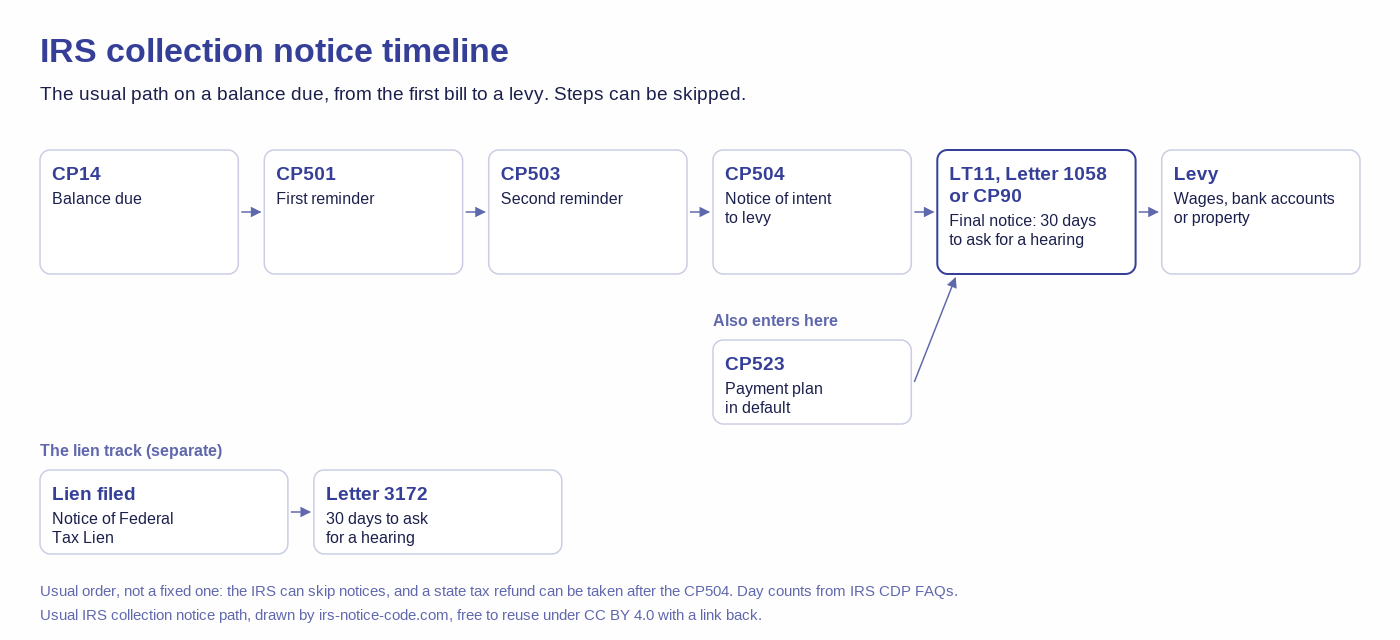
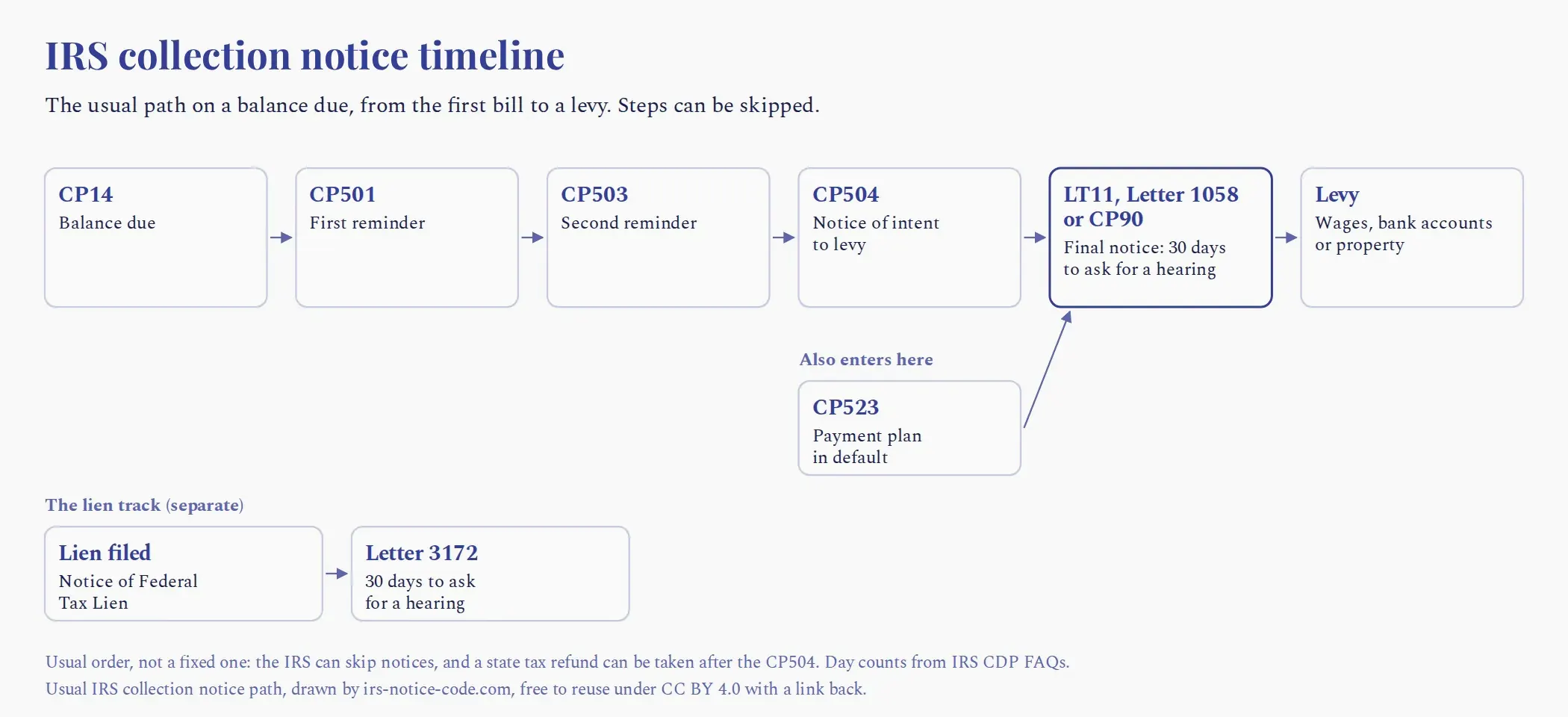
IRS collection notices on a balance due commonly run CP14, CP501, CP503 and CP504, then a final notice of intent to levy: LT11, Letter 1058 or CP90.
30 daysto ask for a hearing after the final notice (LT11, Letter 1058 or CP90)
Each IRS collection notice, in order
CP14 balance due
Pay by the due date printed on the notice
The first bill. It says you owe unpaid tax and asks you to pay by the due date on the notice. The IRS says no interest is charged if you pay the full amount by that date, per its CP14 page.
CP501 first reminder
Still unpaid: interest keeps running
A reminder that the balance is still open because the IRS has had no payment or reply to the first bill. Interest keeps running. See the IRS CP501 page.
CP503 second reminder
Last reminder before the levy warning
The IRS has still not heard from you and the balance is unpaid. This is the last reminder before the levy warning, per the IRS CP503 page.
CP504 notice of intent to levy
A state tax refund can be taken. No hearing right yet
The IRS Notice of Intent to Levy under tax code section 6331(d). It warns that the IRS can take your state tax refund and will start looking for other assets, per its CP504 page.
CP523 payment plan in default, only if a payment plan was missed
Contact the IRS within 30 days of the notice date
Enters the path when a payment plan is missed. The IRS plans to end the plan and levy wages or bank accounts, and asks you to make contact no later than 30 days from the notice date, per its CP523 page.
LT11, Letter 1058 or CP90 final notice of intent to levy
30 days to ask for a hearing · count my days
The notice that carries your hearing rights. You have 30 days from receipt of an LT11 or Letter 1058 to ask for a Collection Due Process hearing on Form 12153, per the IRS CDP FAQs. A CP90 does the same job and also explains your hearing right.
Levy wages, bank accounts or property
Only after the final notice, at least 30 days later
The IRS can levy only after it sends the final notice at least 30 days before the levy, the IRS says on its What is a levy? page. Read how to stop an IRS levy.
This is the usual order, not a fixed one. The IRS can skip a notice, and a state tax refund can be taken after the CP504, before any hearing notice.
Notice of intent to levy
CP504: a state tax refund can be taken; wages and bank accounts need the final notice
Two different letters carry these words. The CP504 is the Notice of Intent to Levy under section 6331(d). After it, the IRS can take a state tax refund, the IRS says on its CP504 page.
For wages, bank accounts and most other property, the IRS needs one more step. Its CDP FAQs say the IRS cannot levy with the CP504 alone. It must first send the final notice of intent to levy with your right to a hearing.
Collection Due Process hearing
Form 12153: to ask for the hearing, within 30 days of the final notice or Letter 3172
A Collection Due Process hearing is held by the IRS Independent Office of Appeals. You can dispute the amount if you have not had the chance before, or ask for a payment plan or another option instead of a levy.
Four letters open the window: LT11, Letter 1058 and CP90 for a levy, and Letter 3172 for a lien. Each gives 30 days, and the request goes on Form 12153, per the IRS CDP FAQs.
Not every levy waits for a hearing. A state tax refund can be taken after the CP504, and the IRS may then send a hearing notice if you still owe.
CP504 vs LT11: which one gives you hearing rights?
| CP504 | LT11, Letter 1058 or CP90 | |
|---|---|---|
| What it is | Notice of intent to levy, a warning | Final notice of intent to levy |
| Hearing right | None | 30 days to ask for a hearing on Form 12153 |
| What the IRS can take | A state tax refund | Wages, bank accounts and most other property, once the 30 days pass |
The LT11 does. The CP504 is a warning and comes with no hearing right. The LT11, Letter 1058 and CP90 are the final notices that start your 30-day clock, per the IRS CDP FAQs.
If you hold an LT11, mark the last day printed on it today. Our deadline calculator counts it for you.
Notice of federal tax lien and IRS Letter 3172
Letter 3172: 30 days to ask for a hearing about the lien
A lien is a separate track. The IRS files a public Notice of Federal Tax Lien to tell creditors it has a legal claim on your property, the IRS says on its federal tax lien page.
Letter 3172 tells you the lien was filed. It gives you 30 days to ask for a Collection Due Process hearing about the filing, per the IRS CDP FAQs. Once the debt is paid in full, the IRS releases the lien within 30 days.
IRS certified mail notice of intent to levy
Certified mail: or registered mail, left at your home or business, or handed to you
The final notice may come by certified or registered mail to your last known address, be left at your home or business, or be handed to you, per the IRS levy page. Read more on certified IRS mail.
If you cannot pay in full, a payment plan can stop the path at any step.
Use this timeline
Download the timeline: SVG · PNG · Print this page. Usual IRS collection notice path, drawn by irs-notice-code.com, free to reuse under CC BY 4.0 with a link back.
Holding one of these notices?
Each step on this path cuts down the time you have to act. A licensed tax pro goes through your notice for free and tells you which step you are on today. Call now, and a licensed tax pro answers around the clock.
Prefer a call back? Send your notice details to get started
Sources
Understanding your CP14 noticeUnderstanding your CP501 noticeUnderstanding your CP503 noticeUnderstanding your CP504 noticeUnderstanding your CP523 noticeUnderstanding your CP90 noticeUnderstanding your LT11 notice or Letter 1058Collection due process (CDP) FAQsWhat is a levy?Understanding a federal tax lienPublication 594, The IRS Collection Process